When it comes to conducting research as an undergraduate student, I would argue that the biggest hurdle is getting your very first research experience. In a bit of a catch-22, most research opportunities require prior research experience, and there is not really an equivalent to actually working in a dry or wet lab (lab courses ≠ research experience). After you get into your first lab and start adding projects, poster presentations, and other research-based metrics to your resume, it becomes much easier to secure your next opportunity or to build towards a career in research and/or graduate school. In this post, I will go over six different ways you can go about securing your first research experience! Note: If you attend a university with limited research opportunities, options #4, #5 and #6 may work best for you.
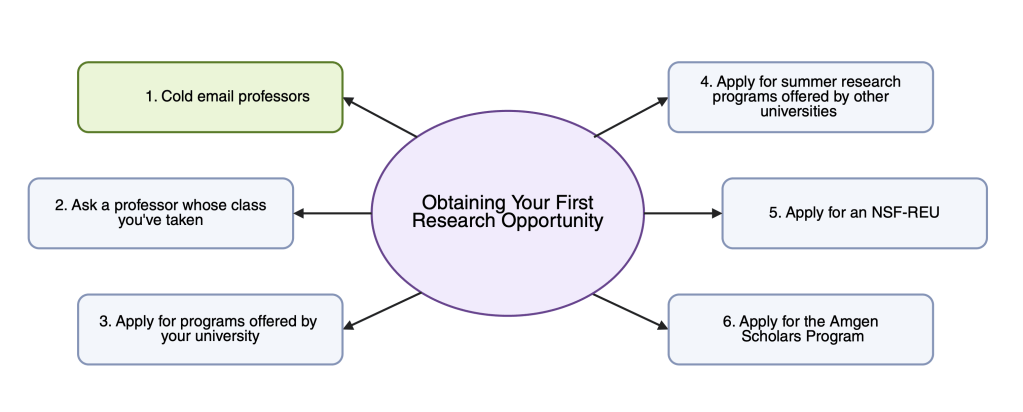
1. Cold Email Professors:
For the majority of undergrads at R1 or R2 universities, cold emailing a professor is the most reliable way to secure their first research opportunity. This involves writing a brief, formal and personalized email with the goal of securing a meeting/interview with the professor. You may need to reach out to a large number of professors before getting a positive response, which can be discouraging, but rest assured that their silence or rejection is not personal—professors are incredibly busy and they may not be actively looking for undergrads at the moment. Though, if a professor says that they are not currently taking students, you can always ask them to refer you to a lab that is!
I highly recommend you start with cold emailing since professors expect for students with no prior experience to be reaching out to them. Moreover, devising an email takes significantly less time than applying for research programs, which require essays and letters of recommendation. For detailed information on how to write a cold email, feel free to read my post here!
Another approach is cold emailing a PhD student or postdoc in the lab instead of the professor. That being said, I would recommend that you prioritize reaching out to the professor first. While some professors will delegate you to a graduate student in their lab for any further communication, others do prefer to be the one personally screening and interviewing undergrads. Also, I would only reach out to a PhD student or postdoc if you have a sense of what exactly they are working on (e.g. from seeing their biography on the lab website or maybe seeing their poster at a symposium) and see synergy between their work and your interests. If you have secured a meeting/interview, please see my post here for some tips!
2. Ask a Professor Whose Class You’ve Taken:
One step up from the cold email is reaching out over email or in-person (say during office hours) to a professor you are already familiar with from one of your classes. You can frame your inquiry in the same way you would a cold email, but don’t forget to mention that you are/were a student in their class and enjoyed taking it! Sometimes students overlook this avenue because the professor isn’t working on a topic they are super invested in. If you are already set on the kind of research you want to do, then I wouldn’t compromise on this, but if you are open to exploring, I would really leverage your connections with your professors and reflect on the classes you enjoyed taking.
3. Apply for Programs Offered by Your University:
This one might seem a bit self explanatory, but I wanted to highlight that many universities, especially R1 institutions, offer research programs that involve matching undergraduates with professors. The challenge is that these resources may be hard to locate, and may require you to dig around the university’s website or to ask an academic advisor to point you in the right direction. A good place to start is always the department that houses your major, as program eligibility might include being in the same department.
4. Apply for Summer Research Programs Offered by Other Universities:
Many universities offer summer research programs that are open to students from other universities. Some of them even highly encourage applications from students that attend universities with limited research opportunities available. The programs usually provide financial support, professional development workshops, and even a symposium at the end of the program, providing a great opportunity to present your research and network!
While these programs are fantastic, the application process is competitive. The applications typically require essays, resume/CV, college transcript, and letters of recommendation, so keep an eye on their deadlines and start preparing for them well in advance!
I am currently working on compiling a list of such programs into a spreadsheet (coming soon).
5. Apply for an NSF REU:
Another way universities can offer summer research opportunities to undergraduate students from other institutions is through the National Science Foundation (NSF) Research Experiences for Undergraduates (REU). To get started, take a look at the official NSF REU website and search through their directory. The most important thing you will want to check for a particular REU is the “Abstract of award,” as this will describe the participant eligibility (e.g. having an interest in pursuing a PhD). Please note that a small number of REUs do require prior research experience, but that should be outlined in the abstract.
6. Apply for the Amgen Scholars Program:
Finally, the last avenue I would like to highlight is the Amgen Scholars Program. This is a highly competitive summer research program open to sophomores, juniors, or non-graduating seniors (who are returning in the fall to continue their undergraduate studies) that provides hands-on research experience and financial support for the duration of the program. Similar to the aforementioned programs, there is a symposium at the end.
To apply for this program, you must have an interest in pursuing a Ph.D. or M.D.-Ph.D. While the program is highly competitive with only about 140 students participating across the 10 host institutions per year, the program does encourage applications from students attending universities with limited opportunities for conducting research.
The 10 host institutions for the program include Caltech, Columbia, Duke, Harvard, Howard University, Johns Hopkins, Stanford, UCB, UCLA, UCSF, UNC-Chapel Hill, UT Southwestern Medical Center, WashU in St. Louis, and Yale. Please note that each host has a separate application process and that requirements may vary! To get started, take a look at the official Amgen Scholars Program website (U.S. programs) and explore the program pages for the various host institutions to see what their specific requirements are! For 2025, the application deadline was February 1st.

 Aspiring PhD